On this page
Start here
A window is an observation feature
A viewing window is worth considering if you often want to see browning progress and the model provides a useful view of the food you cook. It is not a doneness sensor, and it does not remove every reason to open a drawer. Treat it as a convenience feature rather than a promise that dinner needs no checks.
The feature is most relevant when you would actually look through it during your routine. A window that faces away from your cooking position or sits too low to read comfortably may contribute little. Compare placement and lighting alongside the product's capacity and controls.
Check what you can see
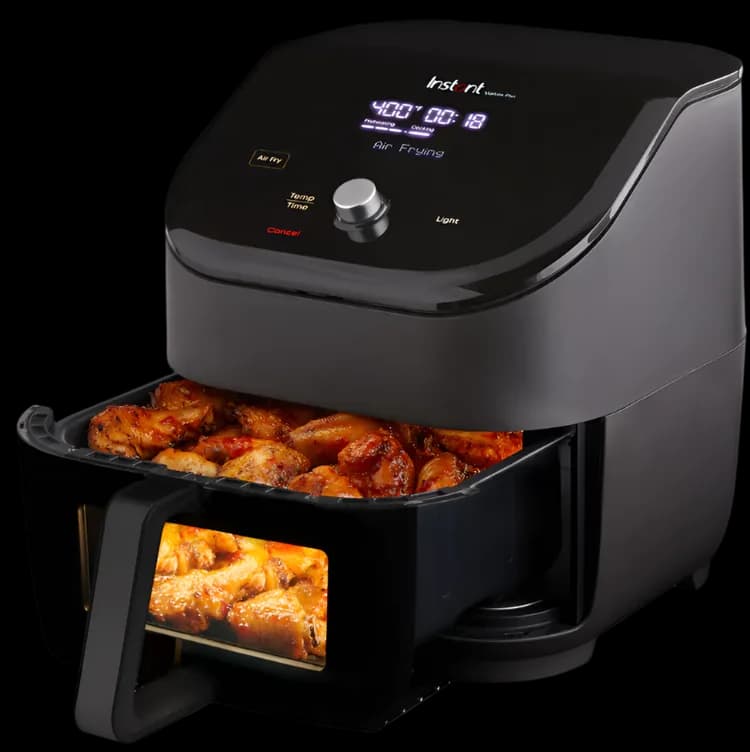
Instant markets ClearCook models with a visible cooking chamber. Moulinex's Easy Fry Infrared product page also identifies a viewing window. These examples establish the feature's availability. They do not prove identical visibility across basket shapes, lighting systems, or food arrangements.
Look for photographs or demonstrations of the exact reference with the drawer in its normal position. Check whether an internal light is documented and how it is controlled. A dark product photo cannot tell you whether the view will be useful at your counter height.
Match the view to your food
A window may show the front of a tall item while hiding food behind it. A broad layer can present a different view from a deep load. If your typical food obscures the cooking surface, the convenience may be smaller than you expect. Do not let a feature demonstration replace a fit assessment.
Imagine watching one recurring meal from where you normally stand. Can you see the area you care about? Would a rack, dish, or liner obscure it? Confirm accessory compatibility separately. The goal is to evaluate the actual view, not to invent a loading arrangement purely to make the window useful.
Colour does not establish safe doneness
Looking through a window can help you notice visible changes. It cannot establish the internal condition of every food. Use the appropriate cooking instructions and official food-safety guidance for the food involved. Keep those checks in the meal plan even when browning is easy to watch.
Likewise, a window does not eliminate a model's requirement to turn, shake, inspect, or handle food according to its instructions. Do not assume a closed drawer is always the right choice merely because you can look inside. Follow the operating guidance rather than a convenience slogan.
Add window care to the cleanup comparison
Check the manual's guidance for the window and drawer. Ask whether there are cleaning restrictions or inaccessible areas you should understand. Treat the cleaning instructions as model-specific. A dishwasher claim for one removable part is not evidence that every window component can be washed the same way.
Compare a windowed model with a similar non-windowed model using the same priorities: food fit, control access, counter space, cleaning, and final price. If the window is the only material difference, decide how often you will use it rather than assigning it automatic value.
The counter-angle test
Imagine the air fryer sits beside your preparation area, with its window visible from your normal position. Observation may be convenient. If the same model must face a wall or sit low behind another appliance, the window may add little. Check the actual view before comparing a price premium. You should also consider whether your ordinary dish or food arrangement hides the area you want to watch. A window remains optional when it fails those practical checks, even if it looks attractive in an ideal product demonstration.
When to prioritize it
Prioritize visibility if it makes a common task easier and is comfortable from your usual position. Treat it as optional if you mostly use routines that already require opening for other checks or if visibility is poor. A well-fitted appliance without a window can be a better purchase than a poorly fitted one with it.
- Verify a window and light on the exact regional reference.
- Assess visibility at your counter height.
- Consider food, dish, and rack obstruction.
- Read cleaning guidance for the windowed drawer.
- Keep appearance checks separate from safe-doneness checks.
- Compare the price premium against how often you will use the view.
Behind this guide
Sources & editorial method
This guide combines original editorial decision support with the linked documentation. It is not a hands-on product test. Check the exact regional model and its manual before purchasing or using an appliance.
- Instant Vortex Plus 6QT ClearCook product details ↗Checked
- Moulinex Easy Fry Infrared EZ832HF0 ↗Checked