On this page
Start here
Dishwasher safe applies to an identified component
Check every removable component individually: permitted in the dishwasher, permitted only by hand, or unclear and needing support advice. Leave the main electrical housing out of the washing decision. Create a short list of the parts you intend to wash: basket, insert, tray, lid or another approved accessory. Read the matching instructions for each. A dishwasher statement on a product page may describe only particular removable pieces. It does not include the electrical housing or establish that an unrelated accessory is suitable. Keep the part name and exact appliance reference together instead of assigning one cleaning answer to the entire machine.
Tefal's AH900015 support page permits dishwasher cleaning of its removable pieces while recommending hand washing to prolong the bowl or tray's life. That is a specific manufacturer's care distinction, not a universal lifespan prediction. If you own another Actifry reference, check its documentation. A familiar product family name does not make every lid, paddle or coating subject to the same care procedure.
Compare the complete household workflow
Dishwasher convenience depends on when the machine runs and when you next need the appliance. A basket waiting in an unstarted dishwasher is not ready for lunch. Hand washing also needs space, the permitted tools and enough time for the prescribed drying steps. Compare those real sequences rather than counting only the seconds spent putting a component on a rack. The most useful choice is one your household can complete consistently.
Imagine cooking in the evening but using the air fryer again for breakfast. If the dishwasher usually waits until the following night, the basket may be unavailable for the next meal. A permitted hand-wash routine could suit that schedule better. This example does not claim one method always cleans more thoroughly. It shows that component readiness and the appliance's supported care should be assessed together.
An exact Crispi example: glass, lid and PowerPod have different rules
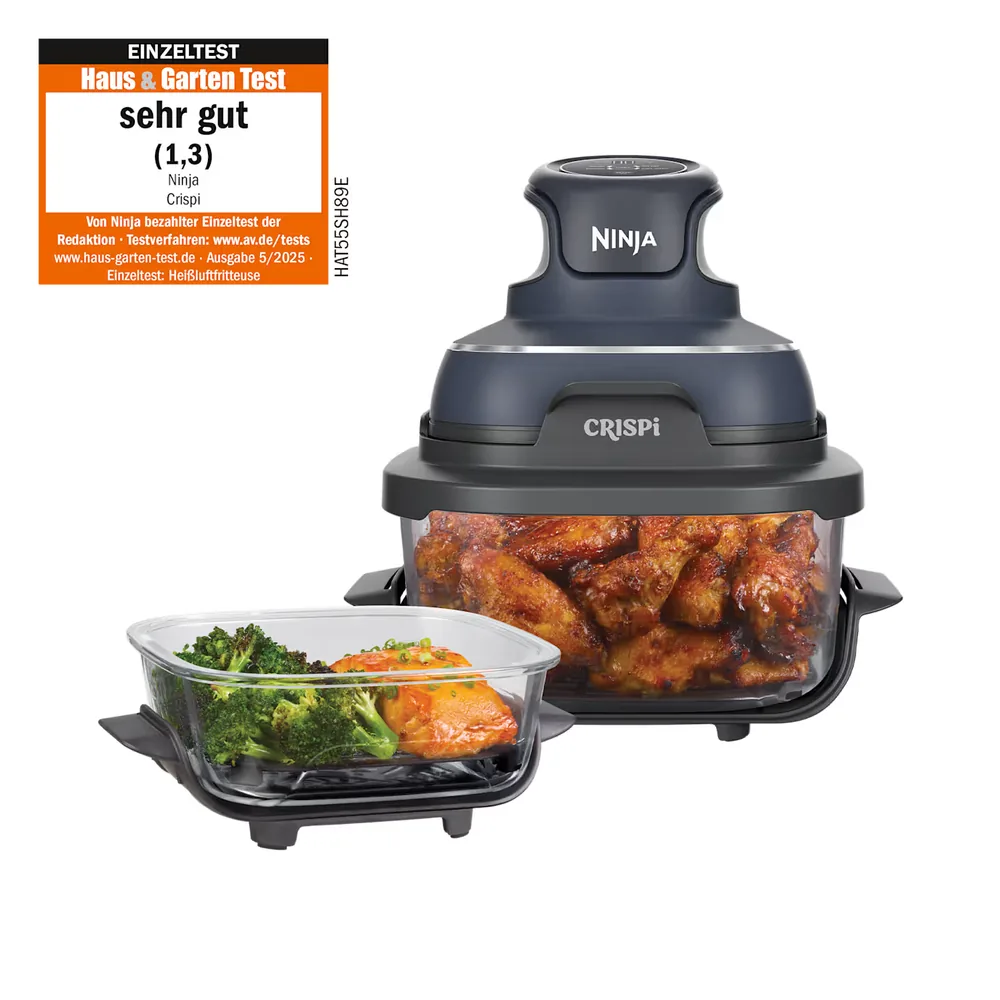
Ninja’s public FN100EU cleaning instructions explicitly include FN101EUGY. They permit the glass containers, adapter and crisper plates in the dishwasher, while storage lids are top-rack only or hand washed. The PowerPod must never be immersed or put in the dishwasher. A photograph of a washable glass bowl therefore tells you nothing about the heating unit’s cleaning method.
For this family, Ninja says to cool the glass gradually to room temperature before putting it into water, a sink or the dishwasher. Its care article also says not to remove the rubber feet for cleaning. If your routine involves serving from the glass and washing immediately afterward, allow time for that cooling step. Use the matching Pro or DualZone instructions for those models; do not extend the original FN100EU permission to a different system.
Read the small care conditions
Check whether the instructions specify placement, programme or detergent limitations for the part. Use the dishwasher's own guidance as well where relevant. Avoid nesting a component in a way that prevents its intended cleaning or leaves it under pressure from other cookware. Do not remove attached pieces merely to make the basket fit a rack unless the appliance instructions say they are removable for cleaning.
If a part has visible damage, a changed surface or an uncertain attachment, resolve that issue before selecting either washing method. Putting it through a dishwasher does not test whether it remains serviceable. Likewise, a stain that survives an allowed cycle does not authorise stronger chemicals. Record what was attempted and consult the matching care guidance. Cleaning choice and condition assessment are related but separate decisions.
Keep the permission with the part record
After cleaning, follow the appliance's drying and reassembly procedure. Account for the complete accessory before the next use, and tell other users if something is still in the dishwasher. A simple ready-state note is more helpful than a general household rule that all air-fryer parts go in the machine. Replacement accessories may arrive with different care instructions even when their purpose looks the same.
Keep the source for dishwasher permission in your household appliance record. When the manual changes or you replace a part, review that permission rather than relying on memory. If the instructions are silent, ask the manufacturer instead of assuming that heat resistance during cooking establishes dishwasher suitability. The result should be an explicit part-by-part choice, with a cleaning and return-to-use sequence that fits the actual kitchen schedule.
Behind this guide
Sources
Check the exact regional model and its manual before purchasing or using an appliance.
- Tefal Actifry Family AH900015 support ↗Checked
- Ninja FN100EU care: component washing and gradual glass cooling ↗Checked