On this page
Start here
Compare the energy used for the same meal
Compare air-fryer energy costs by the electricity used for an equivalent meal, including all required batches and relevant preparation stages. Rated wattage alone does not tell you the final cost. A more powerful appliance running for less time and a less powerful one running longer cannot be ranked from their labels alone.
Keep estimates separate from measurements. A simple calculator is useful for exploring assumptions, but its result is not a tested savings claim. If you lack measured energy for the compared meals, label the calculation clearly and explain what has been assumed.
Use kWh and a known electricity price
For an illustrative full-power calculation, divide watts by 1,000 to get kilowatts, multiply by operating hours to estimate kWh, and multiply by the applicable electricity price per kWh. The US Department of Energy's Energy Saver guide discusses tracking appliance energy as part of household energy decisions.
For example, an assumed 1,500 W operating continuously for 20 minutes would use 0.5 kWh. At an assumed price of 0.30 per kWh in your currency, that costs 0.15. These are arithmetic assumptions, not measured consumption for any catalog model or a promised price for your electricity.
Why rated power is not a measured meal
A label gives a rated-power specification. Actual energy depends on how the appliance operates during the task. Do not publish a full-power estimate as though it were a meter reading. Also avoid assigning another appliance's measured consumption to a product with a similar wattage.
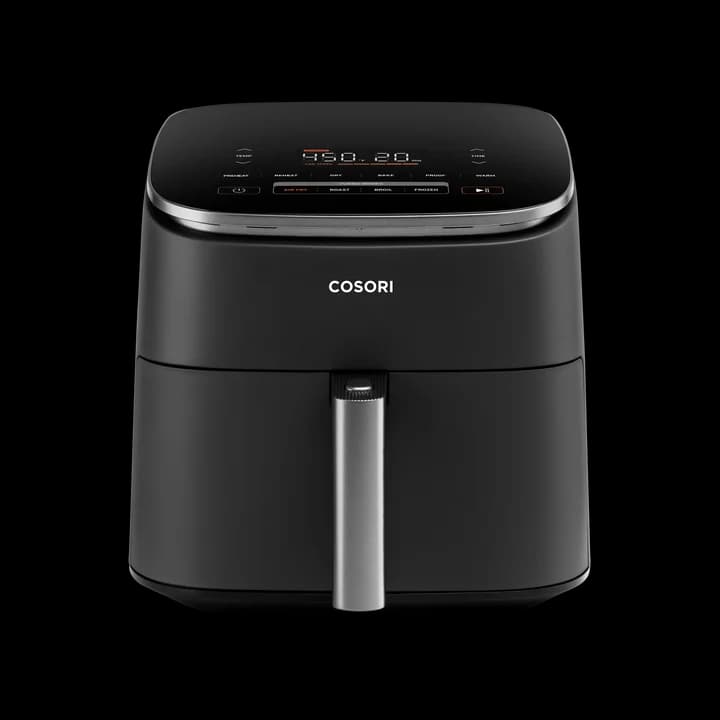
COSORI's US TurboBlaze page lists rated power for its exact reference. That specification can be an input to an explicitly labeled scenario, but it does not establish the kWh required for your quantity of food. Keep the model identity and the assumptions visible in any comparison.
Include batches and the rest of dinner
Suppose one appliance handles the whole planned portion in one load while another needs two. A per-load estimate alone can mislead. Add every required load and any relevant preheating stage described by the instructions. Keep the food quantity and intended outcome comparable.
If the meal still uses a stove or another appliance, include that task when your claim concerns a complete dinner. You can also make a narrower comparison of one component, but label it as such. Do not call a side-dish calculation the energy cost of the entire meal.
Separate running cost from buying value
A small estimated saving per use may take many uses to offset a purchase-price difference. Calculate that break-even scenario only when the inputs are supported, and label future use frequency as an assumption. Do not promise that an air fryer pays for itself for every household.
Convenience, usable space, and cleanup can still justify a purchase even when savings are uncertain. Keep those reasons distinct from electricity claims. A model that requires an unwanted second batch may be a poor practical fit regardless of a favourable headline efficiency percentage.
A two-load scenario
Imagine a hypothetical appliance uses an assumed 0.4 kWh per load for your chosen meal component, but you need two loads. The total scenario is 0.8 kWh before any other relevant stages. Comparing only its first load with another appliance's complete portion would be misleading. Recalculate after matching the quantity and intended outcome. Keep assumed energy visibly labeled, because repeating an estimate does not turn it into a measurement. This whole-task approach can change a comparison even when one appliance has a smaller rated-power number.
A transparent comparison record
Record the food quantity, appliance reference, stages, measured or assumed kWh, price per kWh, and the calculation date. When evidence is incomplete, report the uncertainty rather than a universal percentage. A clear scenario is more useful than a confident savings claim built on mismatched meals.
- Use the same meal quantity and outcome on both sides.
- Label measured consumption and assumed full-power estimates.
- Include all required batches and relevant preheating stages.
- State the electricity price and currency used.
- Separate component costs from whole-meal costs.
- Treat break-even usage frequency as an assumption, not a guarantee.
Behind this guide
Sources & editorial method
This guide combines original editorial decision support with the linked documentation. It is not a hands-on product test. Check the exact regional model and its manual before purchasing or using an appliance.
- US Department of Energy: Energy Saver guide ↗Checked
- COSORI TurboBlaze CAF-DC601-KUS specifications ↗Checked